
This article has been updated based on feedback from Matthieu Halard. The original version used response.data = transformed_data (a copy) instead of std::move. The outputs and analysis have been updated accordingly. A section about noexcept and std::move_if_noexcept has also been added to explain the copies during vector reallocation.
To my greatest satisfaction, I’ve recently joined a new project. I started to read through the codebase before joining and at that stage, whenever I saw a possibility for a minor improvement, I raised a tiny pull request. One of my pet peeves is rooted in Sean Parent’s 2013 talk at GoingNative, Seasoning C++ where he advocated for no raw loops.
When I saw this loop, I started to think about how to replace it:
1
2
3
4
5
6
7
8
9
10
11
12
13
14
15
16
17
18
19
20
21
22
23
24
25
26
27
28
29
30
31
32
33
34
35
36
37
38
39
40
41
42
43
44
45
46
47
48
49
50
51
52
53
54
55
56
57
58
59
60
#include <iostream>
#include <list>
#include <string>
#include <vector>

struct FromData {
    // ...
    std::string title;
    int amount;
};

struct Widget {
    // ...
    std::list<FromData> data;
};

struct ToData {
    // ...
    std::string title;
    int amount;
};

struct Response {
    // ...
    std::vector<ToData> data;
};

Response foo(Widget widget) {
    std::vector<ToData> transformed_data;
    for (const auto& element : widget.data) {
        transformed_data.push_back(
            {.title = element.title, .amount = element.amount * 42});
    }
    Response response;
    // ...
    response.data = std::move(transformed_data);

    return response;
}

int main() {
    Widget widget{.data = {
                      {"a", 1},
                      {"b", 2},
                      {"c", 1},
                  }};

    auto r = foo(widget);

    for (const auto& element : r.data) {
        std::cout << "title: " << element.title << ", amount " << element.amount
                  << '\n';
    }
}

/*
title: a, amount 42
title: b, amount 84
title: c, amount 42
*/
Please note that the example is simplified and slightly changed so that it compiles on its own.
Let’s focus on foo, the rest is there just to make the example compilable.
It seems that we could use std::transform. But heck, we use C++20 we have ranges at our hands so let’s go with std::ranges::transform!
1
2
3
4
5
6
7
8
9
10
11
12
13
14
15
16
17
18
19
20
21
22
23
24
25
26
27
28
29
30
31
32
33
34
35
36
37
38
39
40
41
42
43
44
45
46
47
48
49
50
51
52
53
54
55
56
57
58
59
60
61
62
#include <iostream>
#include <list>
#include <ranges>
#include <string>
#include <vector>

struct FromData {
    // ...
    std::string title;
    int amount;
};

struct Widget {
    // ...
    std::list<FromData> data;
};

struct ToData {
    // ...
    std::string title;
    int amount;
};

struct Response {
    // ...
    std::vector<ToData> data;
};

Response foo(Widget widget) {
    const auto transformed_data = widget.data
                    | std::views::transform([](const auto& element) {
                        return ToData{
                            .title = element.title,
                            .amount = element.amount * 42
                        };
                    });
    Response response;
    // ...
    response.data = {transformed_data.begin(), transformed_data.end()};

    return response;
}

int main() {
    Widget widget{.data = {
                      {"a", 1},
                      {"b", 2},
                      {"c", 1},
                  }};

    auto r = foo(widget);

    for (const auto& element : r.data) {
        std::cout << "title: " << element.title << ", amount " << element.amount
                  << '\n';
    }
}
/*
title: a, amount 42
title: b, amount 84
title: c, amount 42
*/
We have no more raw loops, no more initialized then modified vectors, and the result is the same.
Is this better?
We don’t have to modify a vector that’s definitely better. But when I proposed such a change, one of my colleagues asked a question.
transformed_data became a view. When we populate response.data, do we actually copy all the elements of the view?
I couldn’t answer the question with confidence, hence this article.
I slightly updated both examples,and updated ToData to this:
1
2
3
4
5
6
7
8
9
10
11
12
13
14
15
16
17
18
19
20
21
22
23
24
25
26
27
28
29
30
31
32
33
34
35
36
37
struct ToData {
    // ...
    std::string title;
    int amount;

    ToData() {
        std::cout << "ToData()\n";
    }

    ToData(std::string title, int amount) : title(title), amount(amount) {
        std::cout << "ToData(std::string title, int amount)\n";
    }

    ToData(const ToData& other): title(other.title), amount(other.amount) {
        std::cout << "ToData(const ToData& other)\n";
    }

    ToData& operator=(const ToData& other) {
        std::cout << "ToData& operator=(const ToData& other)\n";
        title = other.title;
        amount = other.amount;
        return *this;
    }

    ToData(ToData&& other)
        : title(std::exchange(other.title, "")),
          amount(std::exchange(other.amount, 0)) {
        std::cout << "ToData(ToData&& other)\n";
    }

    ToData& operator=(ToData&& other) {
        std::cout << "ToData& operator=(ToData&& other)\n";
        title = std::exchange(other.title, "");
        amount = std::exchange(other.amount, 0);
        return *this;
    }
};
I also had to remove the usage of designed initializers as ToData is no longer an aggregate.
The output for the original version using push_back is not particularly surprising.
1
2
3
4
5
6
7
8
9
10
11
12
13
14
ToData(std::string title, int amount)
ToData(ToData&& other)
ToData(std::string title, int amount)
ToData(ToData&& other)
ToData(const ToData& other)
ToData(std::string title, int amount)
ToData(ToData&& other)
ToData(const ToData& other)
ToData(const ToData& other)
writing response.data
wrote response.data
title: a, amount 42
title: b, amount 84
title: c, amount 42
In the for loop, we construct ToData and move it into the vector. The copies you see are from vector reallocations — when the vector runs out of capacity and needs to grow. Thanks to std::move, the final assignment to response.data transfers ownership of the entire buffer without any element-wise copies.
You might wonder why the reallocations trigger copies instead of moves. The reason is that the move constructor of ToData is not marked noexcept. During reallocation, std::vector uses std::move_if_noexcept to maintain the strong exception safety guarantee. If a move could throw midway through reallocation, some elements would already be moved out and the vector would be left in an inconsistent state. So it falls back to copying. By marking your move operations noexcept, those reallocation copies would become moves as well — yet another reason to always mark your move operations noexcept!
On the other hand, for the version using ranges, the output is shorter and different!
1
2
3
4
5
6
7
8
9
10
11
12
13
14
filling response.data
ToData(std::string title, int amount)
ToData(ToData&& other)
ToData(std::string title, int amount)
ToData(ToData&& other)
ToData(const ToData& other)
ToData(std::string title, int amount)
ToData(ToData&& other)
ToData(const ToData& other)
ToData(const ToData& other)
filled1 response.data
title: a, amount 42
title: b, amount 84
title: c, amount 42
Nothing actually happens within the transformation pipeline! Everything is happening lazily when we use the results of the pipeline and actually construct a vector. Now that we use std::move in the original version, the number of special function calls is about the same — the laziness of ranges doesn’t give us an edge here since both versions suffer from reallocation copies.
But we all know that the original version is not optional even with a raw loop. Let’s use emplace_back! Oh and we also forgot about calling std::vector<T>::reserve to avoid reallocations! Here is the code producing the below output.
1
2
3
4
5
6
7
8
ToData(std::string title, int amount)
ToData(std::string title, int amount)
ToData(std::string title, int amount)
writing response.data
wrote response.data
title: a, amount 42
title: b, amount 84
title: c, amount 42
Now the raw loop version has a clear advantage! In this version, we only have a single constructor call per item — no copies, no moves — while in the ranges version, we have a constructor plus a move for each item and also copies from reallocations.
Note that since C++23, you can also use
std::ranges::to<std::vector<Todata>>to construct the finalvector, but it didn’t result in any difference in terms of the number of special member function calls.
Is that so bad? Probably not. Move operations are cheap, that’s why they were introduced! Probably this is just an acceptable price to pay for more readable code. But our “more readable code” also features a lambda so let’s just say that we have assumptions.
Let’s also run benchmarks.
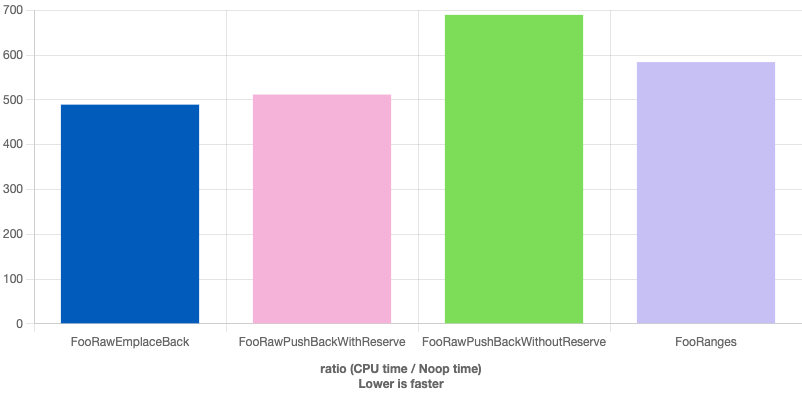
Based on Quick Bench, the enhanced raw loop version is about 20% faster on Clang than the raw loop version. The results are slightly different with GCC, but the raw loop version is still 10% faster. It’s also worth noting that the original version with a push_back and without the reserve is 20-30% slower than the other two versions! By adding the reserve but still using push_back, the code is between the ranges and the raw loop with emplace_back version.
What does this mean in real life?
It depends. You must measure. Don’t forget about Amdahl’s law which says that “the overall performance improvement gained by optimizing a single part of a system is limited by the fraction of time that the improved part is actually used.”
If this happens to be a bottleneck, use the emplace_back version without hesitation and don’t forget about reserving enough space in memory for all the elements.
I think you have no reason to use the push_back version and definitely not without calling reserve.
Otherwise, if you write code where you also do some network calls or read from the database or from the filesystem, these differences are negligible and you should go with the version that you find the most readable.
That’s up to you.
Conclusion
Using ranges or algorithms has several advantages over raw loops, notably readability. On the other hand, as we’ve just seen, sheer performance is not necessarily among those advantages. Using ranges can be slightly slower than a raw loop version. But that’s not necessarily a problem, it really depends on your use case. Most probably it won’t make a bit difference.
Connect deeper
If you liked this article, please
- hit on the like button,
- subscribe to my newsletter
- and let's connect on Twitter!
- if you're preparing for a C++ quant/trading interview, check out GetCracked